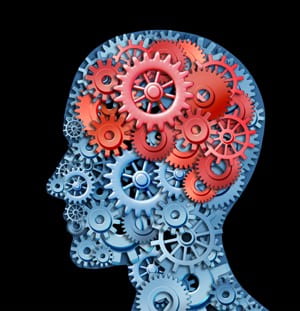
1. Information Processing Theory
📌 Core Idea:
The Information Processing Theory draws an analogy between the human mind and a computer system – suggesting that we process incoming information through a series of stages, just like a computer takes in input, processes data, stores files, and retrieves them when needed. This approach marked a major shift in psychology during the 1950s-60s, moving away from behaviorism (which focused only on observable behavior) and toward an interest in the internal mental processes that occur between a stimulus and a response.
The Atkinson & Shiffrin Multi-Store Model (1968):
One of the most influential versions of this theory, it breaks information processing into three distinct memory systems:
- Sensory Memory
- Extremely brief (~250-500 milliseconds)
- Captures raw sensory input (what we see/hear/touch)
- Acts as a buffer for incoming stimuli
- Short-Term Memory (STM)
- Limited capacity (about 7 ± 2 items, as per Miller’s magic number)
- Duration: ~15-30 seconds
- Information is held here temporarily for immediate use
- Long-Term Memory (LTM)
- Practically unlimited capacity and duration
- Requires meaningful encoding (example, through repetition, association, or emotional relevance)
- Information flows from one system to another sequentially, but attention and rehearsal determine whether something makes it into long-term storage.
📌 Expanded Theoretical Significance:
Information Processing Theory isn’t just about memorization – it helps explain attention, encoding strategies, learning difficulties, and even decision-making. It laid the foundation for subfields such as:
- Educational Psychology (How do students process instructions?)
- Human Factors (How do users interact with machines/software?)
- Artificial Intelligence (How do machines model human thought?)
It also inspired more nuanced memory models later on – like Baddeley’s Working Memory and Craik & Lockhart’s Levels of Processing.
📌 Real-Life Learning Example:
Let’s say you’re trying to memorize the definition of “cognitive dissonance”:
- You see the term in your textbook (Sensory memory)
- You repeat it mentally or aloud a few times (Short-term memory)
- You connect it to a personal experience of feeling conflicted after buying something expensive (Elaborative rehearsal → Long-term memory)
This theory explains each step in that process, and why some study strategies (like rote memorization) are less effective than others (like deep, meaningful learning).
📌 Classroom & Study Applications:
Use visual aids, spoken explanations, and note-taking together to engage multiple memory systems. Break complex material into chunks (chunking helps STM cope with limited capacity). Practice retrieval (not just reviewing) – this strengthens the memory trace in long-term memory.
2. Working Memory Model – Baddeley & Hitch (1974)
📌Core idea:
The Working Memory Model redefined our understanding of short-term memory by treating it not as a passive “box” but as an active workspace. It’s where conscious mental operations happen – solving problems, holding onto a phone number while dialing, or translating thoughts into language.
This theory challenged the idea of a single short-term memory store (as proposed by the multi-store model) and introduced a dynamic system with multiple components working together.
📌Components of the Model:
- Central Executive
- Acts like the brain’s “manager”
- Directs attention, coordinates the other subsystems
- Has limited capacity but high control functions (decision-making, shifting attention)
- Phonological Loop
- Handles verbal and auditory info
- Subdivided into:
- Phonological store (inner ear) – holds sounds briefly
- Articulatory rehearsal process (inner voice) – refreshes info via repetition
- Visuospatial Sketchpad
- Deals with visual and spatial info
- Helps us imagine layouts, navigate spaces, visualize objects
- Episodic Buffer
- Integrates information from different sources
- Links working memory with long-term memory and time-based sequencing
📌Origin & Significance:
Alan Baddeley and Graham Hitch developed this model in response to limitations of the multi-store model, especially its oversimplification of STM. They observed that people could do two tasks at once (like reading and listening), suggesting the presence of multiple short-term systems. This was pivotal in showing that STM is active and multifunctional, not just temporary storage.
📌Theoretical Relevance:
This model explains phenomena such as,
- Why multitasking is difficult when two tasks use the same subsystem (example, two verbal tasks).
- How mental math, language comprehension, and spatial orientation function simultaneously.
It also inspired neuropsychological investigations, where damage to different subsystems led to specific memory impairments, giving biological support to the theory.
📌Real-Life Learning Example:
Imagine you’re solving a math problem in your head.
- The central executive decides what to do first.
- You use the phonological loop to repeat the numbers.
- The visuospatial sketchpad helps visualize the digits or number line.
- The episodic buffer might retrieve a memory of how you solved a similar problem.
📌Classroom & Study Applications:
- Use dual coding strategies: combine visuals + verbal explanations to engage both subsystems.
- Avoid multitasking with the same modality (e.g., listening to lyrics while writing an essay).
- Encourage mental rehearsal: repeating and visualizing enhances working memory performance.
- Teach metacognitive control: students benefit from knowing how to consciously shift attention and manage cognitive load.
3. Levels of Processing Theory – Craik & Lockhart (1972)
📌Core idea:
The Levels of Processing (LOP) Theory challenged the traditional idea that memory strength depends on which “store” (STM or LTM) the information passes through. Instead, it proposed that the depth at which we process information determines how well we remember it. In other words, memory is not about where info goes, but how we think about it.
📌Shallow vs Deep Processing:
Craik and Lockhart outlined a continuum of processing depth, from shallow (surface-level) to deep (meaning-based):
- Shallow Processing
- Structural: Focused on appearance (example, is the word in CAPITALS?)
- Phonemic: Focused on sound (example, does it rhyme with “train”?)
- Minimal cognitive effort = weak memory trace
- Deep Processing
- Semantic: Focused on meaning (example, is it a type of fruit?)
- Elaboration: Linking to personal experiences or other concepts
- More cognitive arrangement = stronger, longer-lasting memory
📌Origin & Significance:
Craik and Lockhart’s theory was revolutionary because it moved memory research away from structural models and toward functional explanations. Rather than thinking of memory as compartments, it asked: What mental operations create lasting memories? This led to a surge in research on encoding strategies, metacognition, and learning efficiency. It also provided a framework for designing effective study techniques, especially in educational psychology.
📌Theoretical Impact:
LOP theory helped,
- Explain why rote memorization is often ineffective – it encourages shallow processing.
- Support the development of elaborative rehearsal as a superior alternative to maintenance rehearsal.
- Inform educational approaches that emphasize conceptual understanding over factual recall.
It also influenced studies in,
- Self-reference effect (we remember things better when they relate to ourselves)
- Depth of processing in dementia and other memory-related disorders
📌Real-Life Learning Example:
Let’s say you’re trying to learn the term “classical conditioning”:
- Shallow: You just repeat the words or memorize the textbook definition.
- Deep: You think of Pavlov’s dogs, relate it to how you flinch when you hear a loud noise, and explain it to someone else.
The deeper, more meaningful your engagement with the concept, the more likely it is to enter long-term memory – not just survive the next exam.
📌Classroom & Study Applications:
- Use “why” questions to push students toward deeper processing.
- Encourage application and synthesis, not just recall (example, “Give a real-life example of operant conditioning”).
- Promote teaching others, storytelling, and analogies – all forms of semantic processing.
- Avoid over-relying on flashcards with single-word answers; encourage elaboration and context-building.
4. Cognitive Load Theory – John Sweller (1988)
📌Core idea:
Cognitive Load Theory (CLT) explains how the limited capacity of our working memory affects learning. When we try to learn too much at once, especially with poorly designed materials, our mental “bandwidth” gets overloaded and learning suffers. This theory has practical, evidence-based applications in instructional design, textbook writing, lesson planning, and even UX design.
📌Three Types of Cognitive Load:
Sweller identified three distinct types of cognitive load,
- Intrinsic Load
- Comes from the complexity of the content itself
- Depends on how many elements must be processed simultaneously
- Example, solving an algebra problem has more intrinsic load than memorizing a fact
- Extraneous Load
- Caused by poor instructional design or distractions
- Includes unclear diagrams, irrelevant content, or clunky interfaces
- Should be minimized
- Germane Load
- Refers to productive mental effort invested in understanding and learning
- This is the “good” load – it leads to schema construction and automation
Effective instruction aims to reduce extraneous load, optimize intrinsic load, and increase germane load.
📌Origin & Significance:
Developed by John Sweller, CLT drew from earlier cognitive models like the Working Memory Model, but made a leap by applying them directly to instructional design. It responded to a growing need in education and e-learning: Why do some lessons feel easier to absorb, while others feel overwhelming? The answer: cognitive overload. This theory became foundational in the field of instructional psychology and influenced:
- Curriculum design
- Online learning platforms
- Multimedia learning principles (especially through Richard Mayer’s work)
📌Theoretical Impact:
Cognitive Load Theory has led to several evidence-backed principles that shape modern teaching.
- Split attention effect: Learners struggle when related info is spread across sources (example, diagram on one page, explanation on another).
- Redundancy effect: Duplicating info (example, identical narration + text) can hinder learning.
- Modality effect: Presenting visual + auditory info (dual channels) reduces overload.
These principles have revolutionized textbook design, instructional videos, and even PowerPoint presentations.
📌Real-Life Learning Example:
You’re watching a video explaining working memory while looking at a diagram and listening to narration.
- If the diagram and narration align smoothly, and the screen isn’t cluttered, cognitive load is balanced.
- But if you’re reading heavy text and listening to the same info and trying to understand a complicated chart, you’re overwhelmed. That’s cognitive overload.
Your brain can’t build connections efficiently when working memory is overtaxed.
📌Classroom & Study Applications:
- Chunk complex content into smaller steps or modules.
- Use visuals + audio, rather than text + text (example, narrated diagrams).
- Avoid clutter: keep instructional design simple and focused.
- Introduce complex material gradually to avoid overwhelming students’ intrinsic load.
- Encourage learners to automate simple procedures (example, math formulae) to free up mental space for problem-solving.
5. Schema Theory – Frederic Bartlett (1932), Expanded by Anderson (1970s-80s)
📌Core idea:
Schema Theory explains how our existing mental frameworks (schemas) shape how we perceive, interpret, store, and retrieve information. We don’t absorb facts passively – we fit them into pre-existing structures of knowledge, which help us make sense of the world. Schemas are like mental filing cabinets: they help organize information, but they also bias what we notice, remember, or even distort.
📌What are Schemas?
A schema is a cognitive structure that represents organized knowledge about a concept, situation, or event. Types of schemas include,
- Person schemas: What you expect from a “teacher” or a “friend”
- Event schemas (scripts): How a “birthday party” usually unfolds
- Self-schemas: Beliefs about yourself (example, “I’m bad at math”)
- Role schemas: Expectations about social roles (example, doctor, waiter)
Schemas are,
- Activated automatically
- Built through experience
- Shaped by culture
- Used to fill in gaps, which may lead to errors or biases
📌Origin & Significance:
Frederic Bartlett was one of the earliest to suggest that memory is reconstructive, not reproductive. In his 1932 study, participants read a Native American folktale (“War of the Ghosts”) and later recalled it, but the retellings became increasingly distorted, fitting the story into Western cultural schemas. This led to the idea that memory is influenced by meaning, expectations, and prior knowledge. Later, schema theory was expanded by cognitive psychologists like Richard Anderson, who applied it to reading comprehension, learning, and education, giving the theory modern relevance.
📌Theoretical Impact:
Schema theory transformed our understanding of,
- Memory: It’s not a tape recorder – it’s reconstructive and shaped by what we already know.
- Learning: New knowledge is easier to acquire when it can be linked to existing schemas.
- Bias: Pre-existing schemas can lead to stereotypes, false memories, or resistance to new ideas.
It provided foundational insight into,
- Reading comprehension
- Eyewitness memory errors
- Cultural cognition
- Concept formation in AI and education
📌Real-Life Learning Example:
Imagine reading a complex neuroscience article.
- If you already have a schema about brain structures, the new info “clicks” into place.
- If you don’t, the material feels abstract and hard to retain, because your brain has no hooks to hang the knowledge on.
That’s why background knowledge plays such a crucial role in learning efficiency.
📌Classroom & Study Applications:
- Activate prior knowledge before teaching new material (example, “What do you already know about memory?”).
- Use analogies and bridges between familiar and unfamiliar content.
- Be aware of cultural and personal schemas – different students may interpret the same material differently.
- Help students build accurate schemas by linking new material to multiple examples.
- Use concept maps or mind maps to make schema connections visible.
6. Gestalt Principles – Max Wertheimer, Kurt Koffka, Wolfgang Köhler (1920s)
📌Core idea:
The Gestalt school of thought argues that we perceive the world in organized wholes, not disconnected bits. Our brains automatically group elements to form patterns, shapes, and meaningful forms, often going beyond the raw sensory input.
“The whole is greater than the sum of its parts.”
That’s the foundational idea behind Gestalt psychology.
📌Key Gestalt Principles of Perception:
- Proximity – Things close together are grouped
- Example, ●● ●● ●● is seen as pairs, not six dots
- Similarity – Things that look alike are grouped
- Example, △△○○△△ is seen as two categories
- Continuity – We prefer smooth, continuous lines
- Our eyes follow curves rather than abrupt shifts
- Closure – We fill in gaps to see complete figures
- Think of the WWF panda logo, it’s incomplete, yet our minds fill in the blanks
- Figure-Ground – We distinguish foreground from background
- Classic example: the Rubin vase (vase or two faces?)
- Symmetry & Order – We prefer balanced, harmonious visuals
📌Origin & Significance:
Gestalt psychology arose as a reaction to structuralism, which tried to break mental experience into basic elements. Instead, Gestalt theorists insisted that the mind organizes experience as a unified whole. These principles laid the groundwork for:
- Cognitive psychology
- Design theory
- Visual arts and UI/UX design
- Human-computer interaction
They explain why certain layouts, fonts, and designs feel “right”, and why some confuse or overwhelm us.
📌Real-Life Learning Example:
Ever used visual mind maps, infographics, or flashcards? The reason they work so well isn’t just because they’re pretty. It’s because they align with Gestalt principles.
- Grouping related ideas = proximity
- Color-coding = similarity
- Clean layouts = continuity & closure
Your brain processes these designs faster and retains them better because they mirror how perception naturally works. Even in note-taking, we chunk ideas visually to help comprehension – that’s Gestalt at play.
📌Classroom & Study Applications:
- Use structured layouts and clear grouping in study materials
- Color-code or symbol-code similar concepts
- Break up long paragraphs and dense visuals (avoid cognitive overload)
- Create diagrams that mirror how relationships exist (not just what info exists)
- Be intentional with spacing, alignment, and visual hierarchy in notes or teaching slides
✍️ Tip: Your study resources don’t just carry content – their design influences cognition. Gestalt principles can make your notes more memorable, digestible, and intuitive. Check out the ‘Psychology Study & Note-taking Tools’ section in Resources.
7. Metacognition – Flavell (1976)
📌Core idea:
Metacognition refers to your awareness and control over your own thinking and learning processes. It’s the ability to monitor, evaluate, and adjust how you learn – like having a mental dashboard for your brain. You don’t just learn something, you think about how you’re learning it, whether it’s working, and what strategy might be better.
“Learning to learn” is the essence of metacognition.
📌Components of Metacognition:
- Metacognitive Knowledge
- Awareness of your strengths, weaknesses, strategies, and tasks
- Example: “I learn better with diagrams than with long texts.”
- Metacognitive Regulation
- Planning: “How will I approach this topic?”
- Monitoring: “Am I understanding this?”
- Evaluating: “Did this study method help me remember better?”
- Metacognitive Experiences
- Emotional or cognitive cues that alert you mid-learning.
- Example: Feeling confused might push you to re-read a section or try another method.
📌Origin & Significance:
John Flavell introduced the term in the 1970s, building on research into children’s cognitive development. Since then, metacognition has become one of the strongest predictors of academic success.
Why? Because learners who think metacognitively can:
- Recognize when they don’t understand something
- Adapt their strategies
- Study smarter, not harder
📌Real-Life Learning Example:
Let’s say you are preparing for an exam. A student with weak metacognition might passively read over and over and hope it sticks. On the other hand, a metacognitive learner would,
- Ask “Do I actually understand this?”
- Quiz themselves or explain the topic aloud
- Notice they’re getting certain types of questions wrong
- Change strategies – maybe switching from notes to diagrams or videos
📌Classroom & Study Applications:
- Encourage learners to ask self-reflective questions:
- “What do I already know?”
- “What’s confusing here?”
- “How will I know I’ve mastered this?”
- Use learning journals or study logs to track strategies and outcomes
- After exams, have students analyze their mistakes and study habits
- Practice think-alouds during problem-solving
- Teach multiple study strategies, then let students evaluate which works best for them
✍️ Tip: At the end of your study session, pause and ask:
“What did I learn today? What worked? What didn’t?”
That’s metacognition for you, to transform your study game.
And that’s a wrap on the 7 Cognitive Psychology Theories Every Student Should Know! These aren’t just abstract ideas. They’re tools to help you become a smarter, more independent, and more effective learner.
Be sure to check out some of my other posts and study resources.

 Smart Psych Study
Leave a comment